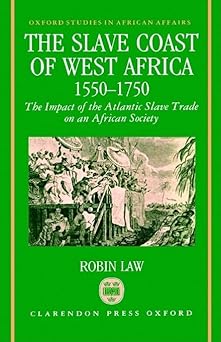
The Slave Coast of West Africa 1550-1750
The Impact of the Atlantic Slave Trade on an African Society
Oxford University Press · Print & ebook · January 1, 1995
This book studies the impact of the Atlantic slave trade on the `Slave Coast' of West Africa, an area covering modern south-eastern Ghana, Togo, Benin, and south-western Nigeria.
We earn from qualifying purchases.
- Who it’s for
- Robin Law examines how Atlantic slave exports reshaped West African societies and the rise of Dahomey.
- Genres
- West African History, Slavery Studies, 18th-Century History
- Published
- Oxford University Press, January 1, 1995
Nearest books
Matched by what the books are about, then ordered by what their readers also loved. Most of these share its genre: West African History.
 A Fistful of ShellsToby Green69% matchAlso shares Slavery Studies
 The Upper Guinea Coast in Global PerspectiveJacqueline Knörr, Christoph Kohl60% match
 Two Princes of CalabarRandy J. Sparks58% matchAlso shares Slavery Studies and 18th-Century History
 An Economic History of West AfricaA.G. Hopkins56% match
 The Slave ShipMarcus Rediker55% matchAlso shares Slavery Studies
 Atlantic Africa and the Spanish Caribbean, 1570-1640David Wheat55% match
 What Britain Did to NigeriaMax Siollun55% match
 African KingdomsSaheed Aderinto55% match
For younger readers: The Royal Kingdoms of Ghana, Mali, and Songhay, African Town, Imperialism
Start with three books, and this one can be the first.
Members get a new edition every morning: a route out from their books to essays, research and talks, with the reason for each.
Start with this bookAbout this book
This book studies the impact of the Atlantic slave trade on the `Slave Coast' of West Africa, an area covering modern south-eastern Ghana, Togo, Benin, and south-western Nigeria. This region was one of the most important sources of slaves for the Atlantic slave trade, and its history provides an exceptionally well-documented illustration of the effect of the trade on the indigenous African societies involved in it.
Continue reading
The expansion of slave exports during the seventeenth and early eighteenth centuries coincided with a period of political disorder, which ended with the rise of the new kingdom of Dahomey. Dahomey was a more militarized and more politically centralized state than those which preceded it in the region, and its distinctive character reflected the impact of the slave trade. This is the first detailed study of the early history of the Slave Coast for over twenty years. Robin Law examines the events which preceded the rise of Dahomey, the organization of the slave trade and its impact on the domestic economy, and the social and political structures of Dahomey and its predecessors. This is a meticulously researched, lucid, and scholarly analysis which makes an important contribution to the history of both early modern European expansion and pre-colonial West Africa.
Dahomey’s Rise
Robin Law examines how Atlantic slave exports reshaped West African societies and the rise of Dahomey.
Come here for
- The slave trade’s organization and effects on the domestic economy
- Dahomey’s social and political structures, alongside those of its predecessors
Expect
- A study of events preceding Dahomey’s rise
- Coverage of the Slave Coast from 1550 to 1750
Where it sits
| West African History | 95% |
|---|---|
| Slavery Studies | 51% |
| 18th-Century History | 28% |
Percentages are BookFrontier’s reading of the book.
Publisher categories
- African History
- Authors
- Robin Law
- Publisher
- Oxford University Press
- Published
- January 1, 1995
- Format
- Print & ebook
- Reading lane
- African History