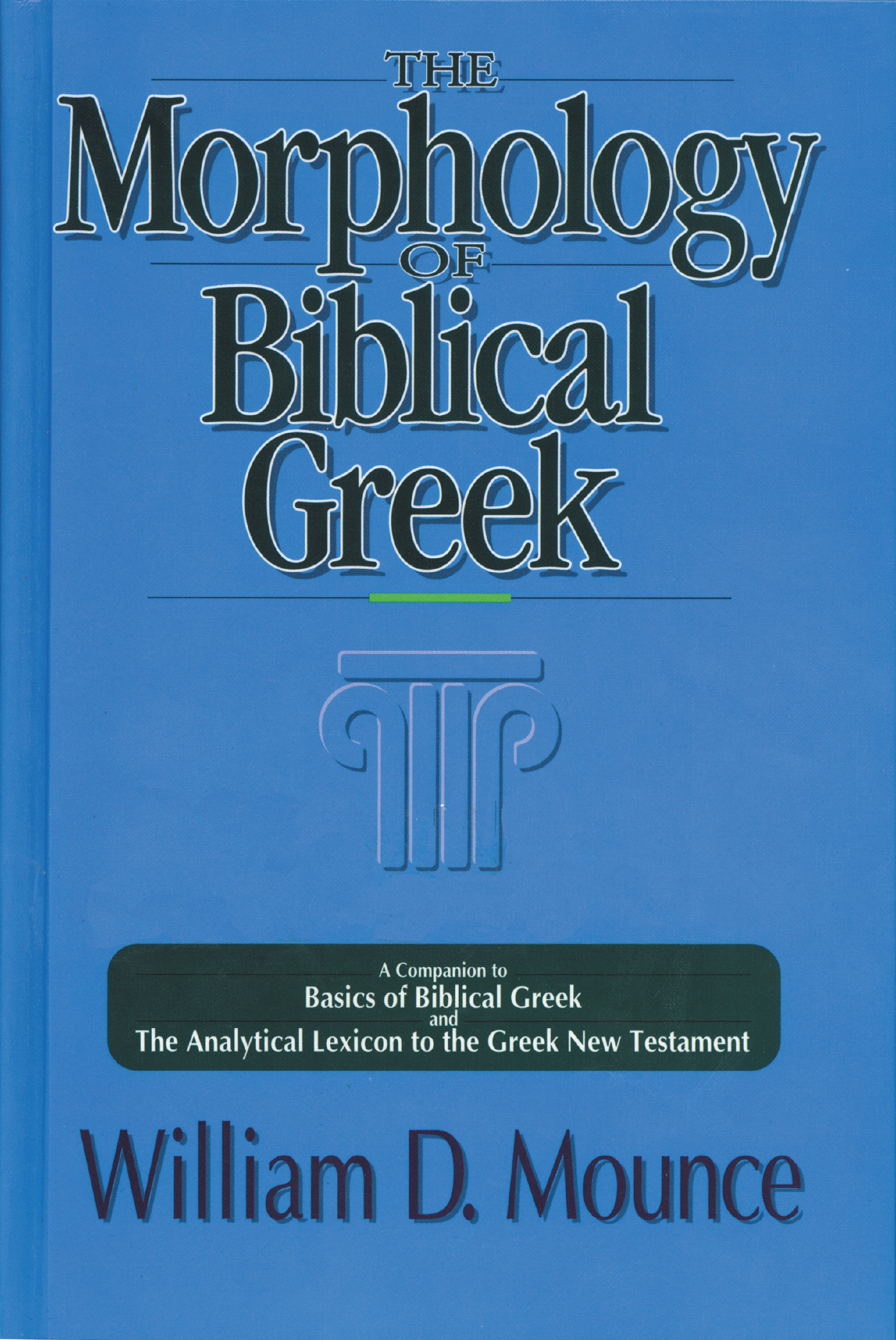
The Morphology of Biblical Greek
A Companion to Basics of Biblical Greek and the Analytical Lexicon to the Greek New Testament
Zondervan Academic · Print & ebook · October 14, 1998
We earn from qualifying purchases.
- Who it’s for
- See how Greek word formation follows rules, with paradigms and New Testament word classifications.
- Themes
- Greek word-formation rules, New Testament Greek morphology, Greek grammatical paradigms
- Genres
- Biblical Language Study, Morphology, Ancient Languages Study
Nearest books
Matched by what the books are about, then ordered by what their readers also loved. Most of these share its genres: Biblical Language Study and Ancient Languages Study.
 Basics of Biblical Greek WorkbookWilliam D. Mounce61% match
 Basics of Biblical Greek GrammarWilliam D. Mounce69% match
 The Development of Greek and the New TestamentChrys C Caragounis64% match
 Syntactical MechanicsBruce A. McMenomy63% match
 A Graded Reader of Biblical GreekWilliam D. Mounce62% match
 English Grammar to Ace New Testament GreekSamuel Lamerson61% match
 The New Linguistic and Exegetical Key to the Greek New TestamentCleon L. Rogers Jr., Cleon L. Rogers III60% match
 MorphologyJeffrey P. Punske60% matchAlso shares Morphology
Start with three books, and this one can be the first.
Members get a new edition every morning: a route out from their books to essays, research and talks, with the reason for each.
Start with this bookAbout this book
The Morphology of Biblical Greek explains, in a way second-year Greek students can understand, how Greek words are formed. It shows that Greek word formation follows a limited set of rules. Once these rules are understood, it becomes clear that forms which once seemed to be irregular or an exception actually follow these morphological rules. The Morphology of Biblical Greek has five parts: 1.The rules that determine how Greek words change. 2.
Continue reading
The rules of verb formation, from augment to personal ending. 3. Paradigms for every type of noun and adjective form, with all the words that belong in each category and any peculiarities of a given word. 4. All the verbs and principal parts, with verbs that follow the same rules grouped together. 5. An index of all words in the New Testament with their morphological category. The Morphology of Biblical Greek contains the most complete set of paradigms for nouns, verbs, adjectives, and pronouns available for New Testament Greek.
Greek Word Formation
See how Greek word formation follows rules, with paradigms and New Testament word classifications.
Come here for
- Rules for how Greek words change and verbs form
- Paradigms for nouns, adjectives, and other word categories
Expect
- Verb forms from augment to personal ending
- An index of New Testament words by morphological category
Where it sits
| Ancient Languages Study | 58% |
|---|---|
| Biblical Language Study | 58% |
| Morphology | 45% |
Percentages are BookFrontier’s reading of the book.
Publisher categories
- Exegesis & Hermeneutics
- Biblical Language Study
- Bible Study Guides
- Jesus, Gospels & Acts
- Authors
- William D. Mounce
- Publisher
- Zondervan Academic
- Published
- October 14, 1998
- Format
- Print & ebook
- Theme
- Greek word-formation rules · New Testament Greek morphology · Greek grammatical paradigms
- Reading lane
- Exegesis & Hermeneutics