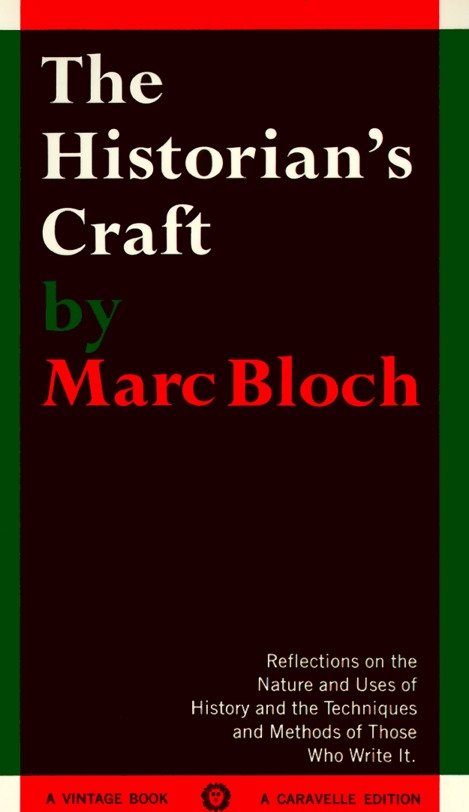
The Historian's Craft
Reflections on the Nature and Uses of History and the Techniques and Methods of Those Who Write It.
Knopf Doubleday Publishing Group · Print & ebook · March 12, 1964
In this classic work, distinguished French economic historian, Marc Bloch, discusses the techniques of historical observation, analysis, and criticism, and the reestablishment of historical causation in assessing events.
We earn from qualifying purchases.
- Who it’s for
- A lucid meditation on how history is made, used, and judged.
- Genres
- Historiography, Studying History, Social History
- Published
- Knopf Doubleday Publishing Group, March 12, 1964
Nearest books
Matched by what the books are about, then ordered by what their readers also loved. Most of these share its genre: Historiography.
 What Is History?Edward Hallett Carr61% match
 The Embarrassment of RichesSimon Schama48% matchAlso shares Social History
 Clues, Myths, and the Historical MethodCarlo Ginzburg, John Tedeschi57% match
 The Hitler of HistoryJohn Lukacs51% match
 The Order of ThingsMichel Foucault56% match
 At the Existentialist CaféSarah Bakewell, Antonia Beamish47% match
 Dangerous GamesMargaret MacMillan63% match
For younger readers: Big Lies, Imperialism
Start with three books, and this one can be the first.
Members get a new edition every morning: a route out from their books to essays, research and talks, with the reason for each.
Start with this bookAbout this book
In this classic work, distinguished French economic historian, Marc Bloch, discusses the techniques of historical observation, analysis, and criticism, and the reestablishment of historical causation in assessing events. What is the value of history? What is the use of history? How do scholars attempt to unpack it and make connections in a responsible manner?
Continue reading
While the topics of historiography and historical methodology have become increasingly popular, Bloch remains an authority. He argues that history is a whole; no period and no topic can be understood except in relation to other periods and topics. And what is unique about Bloch is that he puts his theories into practice; for example, calling upon both his experience serving in WWI as well as his many years spent in peaceful study and reflection. He also argues that written records are not enough; a historian must draw upon maps, place-names, ancient tools, aerial surveys, folklore, and everything that is available. This is a work that argues constantly for a wider, more human history. For a history that describes how and why people live and work together. There is a living, breathing connection between the past and the present and it is the historian’s responsibility to do it justice.
How History Works
A lucid meditation on how history is made, used, and judged.
Come here for
- history as craft, not just chronology
- clear-eyed method with literary grace
Expect
- reflection over recap
- tools for reading history more closely
Where it sits
| Historiography | 97% |
|---|---|
| Studying History | 37% |
| Social History | 28% |
Percentages are BookFrontier’s reading of the book.
Publisher categories
- Teaching Social Studies
- Historiography
- Studying History
- Authors
- Marc Bloch, Peter Putnam, Joseph R. Strayer
- Publisher
- Knopf Doubleday Publishing Group
- Published
- March 12, 1964
- Format
- Print & ebook
- Reading lane
- Teaching Social Studies