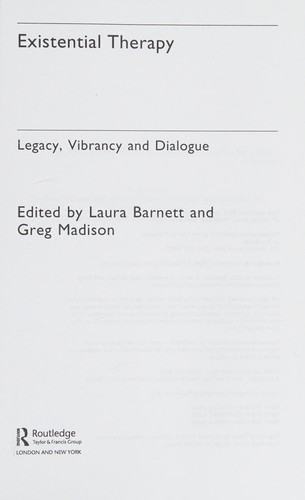
Existential Therapy
Legacy, Vibrancy and Dialogue
Taylor and Francis · Print & ebook · January 14, 2012
In 1958 in their book Existence, Rollo May, Henri Ellenberger and Ernst Angel introduced existential therapy to the English-speaking psychotherapy world.
We earn from qualifying purchases.
- Who it’s for
- A dialogue-led look at how existential therapy has developed and where it may go next.
- Genres
- Existential Approaches, Humanistic Approaches, Existentialism
- Published
- Taylor and Francis, January 14, 2012
Nearest books
Matched by what the books are about, then ordered by what their readers also loved. Most of these share its genres: Existential Approaches and Existentialism.
 Everyday MysteriesEmmy van Deurzen69% match
 Living Your Own LifeSilvia Laengle, Christopher Wurm69% match
 Existential Thought and Therapeutic PracticeHans W Cohn68% match
 Existential Counselling & Psychotherapy in PracticeEmmy van Deurzen67% match
 ExistenceRollo May, Ernest Angel67% match
 Existential–humanistic TherapyKirk J. Schneider, Orah T. Krug67% matchAlso shares Humanistic Approaches
 Existential TherapySusan Iacovou, Karen Weixel-Dixon66% matchAlso shares Humanistic Approaches
 Skills in Existential Counselling & PsychotherapyEmmy van Deurzen, Martin Adams65% match
Start with three books, and this one can be the first.
Members get a new edition every morning: a route out from their books to essays, research and talks, with the reason for each.
Start with this bookAbout this book
In 1958 in their book Existence, Rollo May, Henri Ellenberger and Ernst Angel introduced existential therapy to the English-speaking psychotherapy world. Since then the field of existential therapy has moved along rapidly and this book considers how it has developed over the past fifty years, and the implications that this has for the future.
Continue reading
In their 50th anniversary of this classic book, Laura Barnett and Greg Madison bring together many of today's foremost existential therapists from both sides of the Atlantic, together with some newer voices, to highlight issues surrounding existential therapy today, and look constructively to the future whilst acknowledging the debt to the past. Dialogue is at the heart of the book, the dialogue between existential thought and therapeutic practice, and between the past and the future. Existential Therapy: Legacy, Vibrancy and Dialogue, focuses on dialogue between key figures in the field to cover topics including: - historical and conceptual foundations of existential therapy - perspectives on contemporary Daseinanalysis - the search for meaning in existential therapy - existential therapy in contemporary society. Existential Therapy: Legacy, Vibrancy and Dialogue explores how existential therapy has changed in the last five decades, and compares and contrasts different schools of existential therapy, making it essential reading for experienced therapists as well as for anyone training in psychotherapy, counselling, psychology or psychiatry who wants to incorporate existential therapy into their practice.
Existential Therapy’s Dialogue
A dialogue-led look at how existential therapy has developed and where it may go next.
Come here for
- The field’s historical and conceptual foundations
- Meaning, contemporary Daseinanalysis, and existential therapy in society
Expect
- Comparisons among different schools of existential therapy
- Perspectives on its past, present practice, and future
Where it sits
| Existential Approaches | 100% |
|---|---|
| Existentialism | 49% |
| Humanistic Approaches | 26% |
Percentages are BookFrontier’s reading of the book.
Publisher categories
- Therapy & Counseling
- Authors
- Laura Barnett, Greg Madison
- Publisher
- Taylor and Francis
- Published
- January 14, 2012
- Format
- Print & ebook
- Reading lane
- Therapy & Counseling