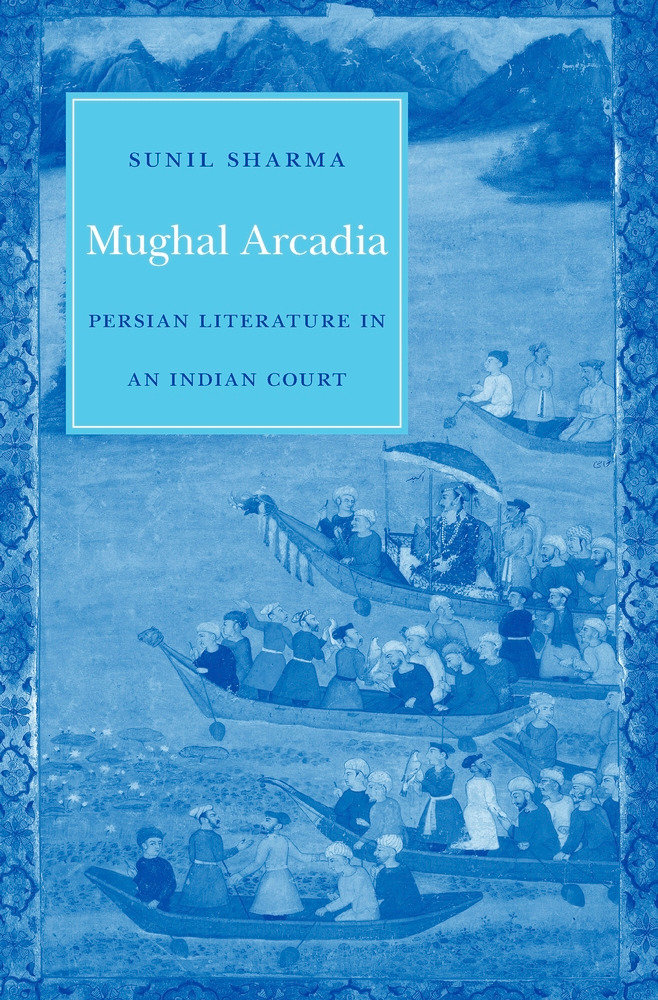
Mughal Arcadia
Persian Literature in an Indian Court
WW Norton · Print & ebook · November 28, 2017
At its height in the sixteenth and seventeenth centuries, the Mughal Empire was one of the largest empires in Eurasia, with territory extending over most of the Indian subcontinent and much of present-day Afghanistan.
We earn from qualifying purchases.
- Who it’s for
- Explore Persian court poetry in Mughal India and the literary paradise imagined beyond Iran.
- Themes
- Persian court poetry in India, Mughal social and cultural life, Persian literary paradise
- Genres
- History of India, Indic Literary Criticism, Middle Eastern Lit Crit
Nearest books
Matched by what the books are about, then ordered by what their readers also loved.
 Persian Myths & LegendsJ.K. Jackson, Dr. Sahba Shayani55% match
 PersiansLloyd Llewellyn-Jones, Basic Books54% match
 Epic IranJohn Curtis, Ina Sarikhani Sandmann52% match
 Indian Ancient OriginsJ.K. Jackson, Roshen Dalal50% matchShares History of India
 The Persian BrideJames Buchan50% match
 A History of IranMichael Axworthy49% match
 The Pearl of DariZuzanna Olszewska49% match
For younger readers: Ancient India (the Ancient World), Where Is the Taj Mahal?, Seasons of Splendour
Start with three books, and this one can be the first.
Members get a new edition every morning: a route out from their books to essays, research and talks, with the reason for each.
Start with this bookAbout this book
At its height in the sixteenth and seventeenth centuries, the Mughal Empire was one of the largest empires in Eurasia, with territory extending over most of the Indian subcontinent and much of present-day Afghanistan. As part of the Persianate world that spanned from the Bosphorus to the Bay of Bengal, Mughal rulers were legendary connoisseurs of the arts. Their patronage attracted poets, artists, and scholars from all parts of the eastern Islamic world.
Continue reading
Persian was the language of the court, and poets from Safavid Iran played a significant role in the cultural life of the nobility. Mughal Arcadia explores the rise and decline of Persian court poetry in India and the invention of an enduring idea—found in poetry, prose, paintings, and architecture—of a literary paradise, a Persian garden located outside Iran, which was perfectly exemplified by the valley of Kashmir. Poets and artists from Iran moved freely throughout the Mughal empire and encountered a variety of cultures and landscapes that inspired aesthetic experiments which continue to inspire the visual arts, poetry, films, and music in contemporary South Asia. Sunil Sharma takes readers on a dazzling literary journey over a vast geographic terrain and across two centuries, from the accession of the first emperor, Babur, to the throne of Hindustan to the reign of the sixth great Mughal, Aurangzeb, in order to illuminate the life of Persian poetry in India. Along the way, we are offered a rare glimpse into the social and cultural life of the Mughals.
Persian Court Poetry
Explore Persian court poetry in Mughal India and the literary paradise imagined beyond Iran.
Come here for
- Persian court poetry’s rise and decline in Mughal India
- The literary paradise imagined through poetry, prose, paintings, and architecture
Expect
- A two-century span from Babur’s accession to Aurangzeb’s reign
- A glimpse into Mughal social and cultural life
Where it sits
| History of India | 90% |
|---|---|
| Indic Literary Criticism | 42% |
| Middle Eastern Lit Crit | 21% |
Percentages are BookFrontier’s reading of the book.
Publisher categories
- Indian & South Asian History
- Iranian History
- Indic Literary Criticism
- Authors
- Sunil Sharma
- Publisher
- WW Norton
- Published
- November 28, 2017
- Format
- Print & ebook
- Theme
- Persian court poetry in India · Mughal social and cultural life · Persian literary paradise
- Reading lane
- Indian & South Asian History