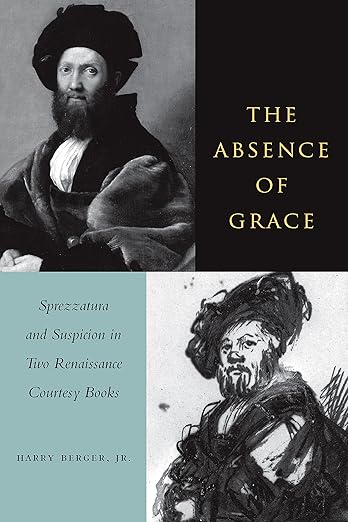
The Absence of Grace
Sprezzatura and Suspicion in Two Renaissance Courtesy Books
Stanford University Press · Print & ebook · October 1, 2000
We earn from qualifying purchases.
- Who it’s for
- A close reading of two Renaissance courtesy books links masculine identity to narratorial authority.
- Genres
- Renaissance Literary Criticism, Italian Literary Criticism
- Published
- Stanford University Press, October 1, 2000
Nearest books
Matched by what the books are about, then ordered by what their readers also loved.
 Hollow MenSusan Gaylard58% matchShares Renaissance Literary Criticism
 Marvelous SolitudeLina Bolzoni, Sylvia Greenup51% matchShares Renaissance Literary Criticism
 The Cheese and the WormsCarlo Ginzburg51% match
 The Secret Language of the RenaissanceRichard Stemp49% match
 What God Kept for HimselfUmberto Grassi49% match
For younger readers: Da Vinci's Tiger, Leonardo's Shadow, Daughter of Venice
Start with three books, and this one can be the first.
Members get a new edition every morning: a route out from their books to essays, research and talks, with the reason for each.
Start with this bookAbout this book
The Absence of Grace is a study of male fantasy, representation anxiety, and narratorial authority in two sixteenth-century books, Baldassare Castiglione's Il libro del Cortegiano (1528) and Giovanni Della Casa's Galateo (1558). The interpretive method is a form of close reading the author describes as reconstructed old New Criticism, that is, close reading conditioned by an interest in and analysis of the historical changes reflected in the text.
Continue reading
The book focuses on the way the Courtier and Galateo cope with and represent the interaction between changes of elite culture and the changing construction of masculine identity in early modern Europe. More specifically, it connects questions of male fantasy and masculine identity to questions about the authority and reliability of narrators, and shows how these questions surface in narratorial attitudes toward socioeconomic rank or class, political power, and gender. The book is in three parts. Part One examines a distinction and correlation the Courtier establishes between two key terms, (1) sprezzatura, defined as a behavioral skill intended to simulate the attributes of (2) grazia, understood as the grace and privileges of noble birth. Because sprezzatura is negatively conceptualized as the absence of grace it generates anxiety and suspicion in performers and observers alike. In order to suggest how the binary opposition between these terms affected the discourse of manners, the author singles out the titular episode of Galateo, an anecdote about table manners, which he reads closely and then sets in its historical perspective. Part Two takes up the question of sprezzatura in the gender debate that develops in Book 3 of the Courtier, and Part Three explores in detail the characterization of the two narrators in the Courtier and Galateo, who are represented as unreliable and an object of parody or critique.
Sprezzatura and Suspicion
A close reading of two Renaissance courtesy books links masculine identity to narratorial authority.
Come here for
- The Courtier’s distinction between sprezzatura and noble-born grazia
- Galateo’s table-manners anecdote in historical perspective
Expect
- Three parts on gender debate, class, political power, and narrators
- Close readings of narrators presented as unreliable or subject to critique
Where it sits
| Italian Literary Criticism | 80% |
|---|---|
| Renaissance Literary Criticism | 75% |
Percentages are BookFrontier’s reading of the book.
Publisher categories
- Italian Literary Criticism
- Authors
- Harry Berger, Harry Berger Jr.
- Publisher
- Stanford University Press
- Published
- October 1, 2000
- Format
- Print & ebook
- Reading lane
- Italian Literary Criticism