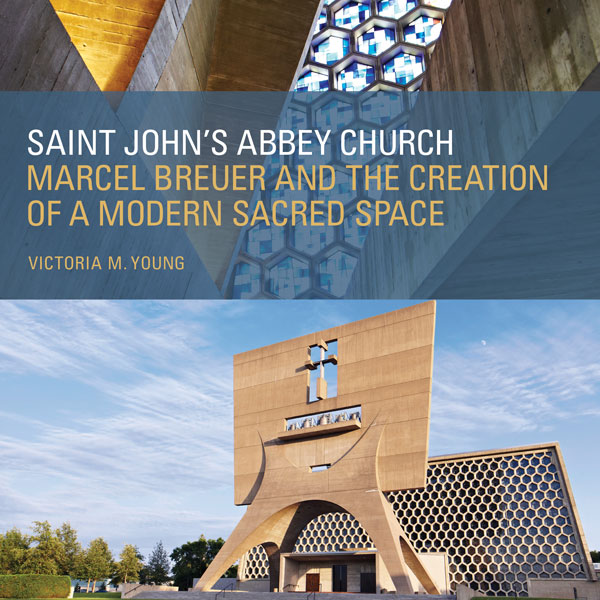
Saint John's Abbey Church
Marcel Breuer and the Creation of a Modern Sacred Space
University of Minnesota Press · Print & ebook · October 21, 2014
In the 1950s the brethren at the Benedictine Abbey of Saint John the Baptist in Collegeville, Minnesota—the largest Benedictine abbey in the world—decided to expand their campus, including building a new church.
We earn from qualifying purchases.
- Who it’s for
- Trace how Breuer and the monks shaped Saint John’s Abbey Church amid midcentury liturgical reform.
- Themes
- Modern sacred architecture, Midcentury liturgical reform, Architect-patron collaboration
- Genres
- Religious Buildings, Architect Monographs, Contemporary Architecture (1945-)
Nearest books
Matched by what the books are about, then ordered by what their readers also loved.
 William Krisel's Palm SpringsHeidi Creighton, Chris Menrad48% matchShares Architect Monographs and Contemporary Architecture (1945-)
 Makers of Modern ArchitectureMartin Filler55% match
 How Buildings LearnStewart Brand55% match
 Why on Earth Would Anyone Build ThatJohn Zukowsky54% matchShares Contemporary Architecture (1945-)
 100 Years, 100 BuildingsJohn Hill54% matchShares Contemporary Architecture (1945-)
 From Bauhaus to Our HouseTom Wolfe51% match
 Twelve ChurchesReverend Fergus Butler-Gallie, Fergus Butler-Gallie51% matchShares Religious Buildings
 Allied Works Architecture: DwellingBrad Cloepfil51% matchShares Architect Monographs
For younger readers: The Prisoners of Breendonk, Mosque, Cathedral
Start with three books, and this one can be the first.
Members get a new edition every morning: a route out from their books to essays, research and talks, with the reason for each.
Start with this bookAbout this book
In the 1950s the brethren at the Benedictine Abbey of Saint John the Baptist in Collegeville, Minnesota—the largest Benedictine abbey in the world—decided to expand their campus, including building a new church. From a who’s who of architectural stars—such as Walter Gropius, Richard Neutra, Pietro Belluschi, Barry Byrne, and Eero Saarinen—the Benedictines chose a former member of the Bauhaus, Marcel Breuer.
Continue reading
In collaboration with the monks, this untested religious designer produced a work of modern sculptural concrete architecture that reenvisioned what a church could be and set a worldwide standard for midcentury religious design. Saint John’s Abbey Church documents the dialogue of the design process, as Breuer instructed the monks about architecture and they in turn guided him and his associates in the construction of a sacred space in the crucial years of liturgical reform. A reading of letters, drawings, and other archival materials shows how these conversations gave shape to design elements from the church’s floor plan to the liturgical furnishings, art, and incomparable stained glass installed within it. The book offers a rare detailed view of how a patron and architect work together in a successful building campaign—one that, in this case, lasted for two decades and resulted in designs for twelve buildings, ten of which were completed. The post–World War II years were critical in the development of religious and architectural experiences in the United States—experiences that came together in the construction of Saint John’s Abbey and University Church and that find their full expression in Victoria M. Young’s account of the process. Using the liturgy of the mid-twentieth century as a cornerstone for understanding the architecture produced to support it, her book showcases the importance of modernism in the design of sacred space, and of Marcel Breuer’s role in setting the standard.
Breuer and the Monks
Trace how Breuer and the monks shaped Saint John’s Abbey Church amid midcentury liturgical reform.
Come here for
- The design dialogue between Marcel Breuer and the monks
- Letters, drawings, and archival materials on the church’s design
Expect
- Design decisions spanning the floor plan, furnishings, art, and stained glass
- A two-decade building campaign that produced designs for twelve buildings
Where it sits
| Religious Buildings | 87% |
|---|---|
| Contemporary Architecture (1945-) | 80% |
| Architect Monographs | 53% |
Percentages are BookFrontier’s reading of the book.
Publisher categories
- Contemporary Architecture (1945-)
- Architects & Firms
- Religion & Spirituality
- Authors
- Victoria M. Young
- Publisher
- University of Minnesota Press
- Published
- October 21, 2014
- Format
- Print & ebook
- Theme
- Modern sacred architecture · Midcentury liturgical reform · Architect-patron collaboration
- Reading lane
- Contemporary Architecture (1945-)