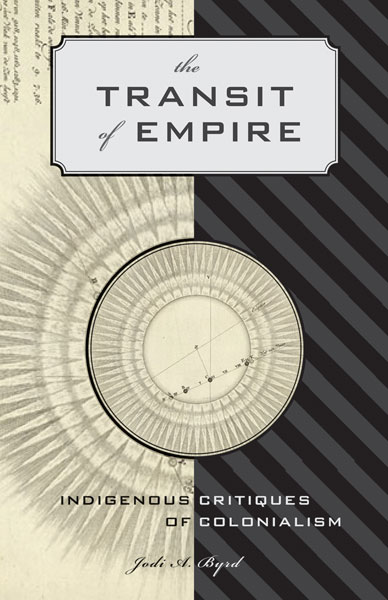
The Transit of Empire
Indigenous Critiques of Colonialism
University of Minnesota Press · Print & ebook · September 6, 2011
In 1761 and again in 1768, European scientists raced around the world to observe the transit of Venus, a rare astronomical event in which the planet Venus passes in front of the sun.
We earn from qualifying purchases.
- Who it’s for
- Jodi A. Byrd traces how transferable “Indianness” shapes U.S. imperial expansion and colonial inclusion.
- Genres
- Indigenous Studies, Colonialism & Its Aftermath, Native American Studies
- Published
- University of Minnesota Press, September 6, 2011
Nearest books
Matched by what the books are about, then ordered by what their readers also loved. Most of these share its genre: Native American Studies.
 Immigrant ActsLisa Lowe48% match
 Decolonizing MethodologiesLinda Tuhiwai Smith64% matchAlso shares Indigenous Studies and Colonialism & Its Aftermath
 Politics and Aesthetics in Contemporary Native American LiteratureMatthew Herman, Matthew D. Herman58% match
 Indian NationCheryl Walker58% match
 Edge of EmpireMaya Jasanoff57% matchAlso shares Colonialism & Its Aftermath
For younger readers: An Indigenous Peoples' History of the United States for Young People, Imperialism, Origin
Start with three books, and this one can be the first.
Members get a new edition every morning: a route out from their books to essays, research and talks, with the reason for each.
Start with this bookAbout this book
In 1761 and again in 1768, European scientists raced around the world to observe the transit of Venus, a rare astronomical event in which the planet Venus passes in front of the sun. In The Transit of Empire, Jodi A. Byrd explores how indigeneity functions as transit, a trajectory of movement that serves as precedent within U.S. imperial history.
Continue reading
Byrd argues that contemporary U.S. empire expands itself through a transferable “Indianness” that facilitates acquisitions of lands, territories, and resources. Examining an array of literary texts, historical moments, and pending legislations—from the Cherokee Nation of Oklahoma’s vote in 2007 to expel Cherokee Freedmen to the Native Hawaiian Government Reorganization bill—Byrd demonstrates that inclusion into the multicultural cosmopole does not end colonialism as it is purported to do. Rather, that inclusion is the very site of the colonization that feeds U.S. empire. Byrd contends that the colonization of American Indian and indigenous nations is the necessary ground from which to reimagine a future where the losses of indigenous peoples are not only visible and, in turn, grieveable, but where indigenous peoples have agency to transform life on their own lands and on their own terms.
Indigeneity in U.S. Empire
Jodi A. Byrd traces how transferable “Indianness” shapes U.S. imperial expansion and colonial inclusion.
Come here for
- An argument linking indigeneity to the movement of lands, territories, and resources
- Discussion of Cherokee Freedmen and Native Hawaiian government reorganization
Expect
- Readings across literary texts, historical moments, and pending legislation
- A critique of multicultural inclusion as a site of continuing colonization
Where it sits
| Indigenous Studies | 60% |
|---|---|
| Native American Studies | 53% |
| Colonialism & Its Aftermath | 36% |
Percentages are BookFrontier’s reading of the book.
Publisher categories
- Colonialism & Its Aftermath
- Native American Studies
- Authors
- Jodi A. Byrd
- Publisher
- University of Minnesota Press
- Published
- September 6, 2011
- Format
- Print & ebook
- Reading lane
- Colonialism & Its Aftermath