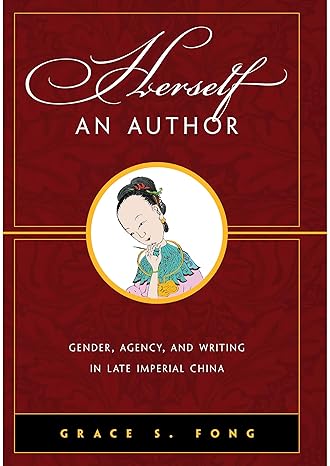
Herself an Author
Gender, Agency, and Writing in Late Imperial China
University of Hawaii Press · Print & ebook · May 8, 2008
"Grace Fong has written a wonderful history of female writers’ participation in the elite conventions of Chinese poetics.
We earn from qualifying purchases.
- Who it’s for
- Grace Fong examines how women’s writing shaped literary practice and self-representation in late imperial China.
- Genres
- Chinese Literary Criticism, Chinese Poetry, Women Authors Criticism
- Published
- University of Hawaii Press, May 8, 2008
Nearest books
Matched by what the books are about, then ordered by what their readers also loved.
 Strange Tales From a Chinese StudioPu Songling, Herbert A. Giles48% match
 I Love a Broad Margin to My LifeMaxine Hong Kingston58% match
 Translingual PracticeLydia Liu, Lydia H. Liu58% matchShares Chinese Literary Criticism
For younger readers: Along the River, Wearing My Mother's Heart, Ode to the Goddess of the Luo River
Start with three books, and this one can be the first.
Members get a new edition every morning: a route out from their books to essays, research and talks, with the reason for each.
Start with this bookAbout this book
"Grace Fong has written a wonderful history of female writers’ participation in the elite conventions of Chinese poetics. Fong’s recovery of many of these poets, her able exegesis and elegant, analytical grasp of what the poets were doing is a great read, and her bilingual presentation of their poetry gives the book additional power.
Continue reading
This is a persuasive and elegant study." —Tani Barlow, author of The Question of Women in Chinese Feminism "In this quietly authoritative book, Grace Fong has brought a group of women poets back to life. Previously ignored by scholars because of their marginal status or the inaccessibility of their works, these remarkable writers now speak to us about the sensualities, pains, satisfactions, and sadness of being a woman in a patriarchal society. Professor Fong—a superb translator of Chinese poetry, prose, and criticism—has rendered the works of these women in a way that is true both to our theoretical concerns and theirs." —Dorothy Ko, author of Cinderella’s Sisters: A Revisionist History of Footbinding "Professor Fong approaches the poetry of Ming-Qing upper-class women as a social-cultural activity that allowed these women to manifest their agency and assert their own subjectivity against the background of virtual and actual networks of fellow female poets. As the distillation of more than ten years of research by one of the leading scholars in this field, this work is a timely contribution that eminently deserves our attention. Given the inclusion of translations of some of the texts discussed, the book provides a comprehensive introduction to the reading of women’s poetry of the Ming-Qing period." —Wilt Idema, Harvard University Herself an Author addresses the critical question of how to approach the study of women’s writing. It explores various methods of engaging in a meaningful way with a rich corpus of poetry and prose written by women of the late Ming and Qing periods, much of it rediscovered by the author in rare book collections in China and the United States. The volume treats different genres of writing and includes translations of texts that are made available for the first time in English. Among the works considered are the life-long poetic record of Gan Lirou, the lyrical travel journal kept by Wang Fengxian, and the erotic poetry of the concubine Shen Cai. Taking the view that gentry women’s varied textual production was a form of cultural practice, Grace Fong examines women’s autobiographical poetry collections, travel writings, and critical discourse on the subject of women’s poetry, offering fresh insights on women’s intervention into the dominant male literary tradition. The wealth of texts translated and discussed here include fascinating documents written by concubines—women who occupied a subordinate position in the family and social system. Fong adopts the notion of agency as a theoretical focus to investigate forms of subjectivity and enactments of subject positions in the intersection between textual practice and social inscription. Her reading of the life and work of women writers reveals surprising instances and modes of self-empowerment within the gender constraints of Confucian orthodoxy. Fong argues that literate women in late imperial China used writing and reading to create literary and social communities, transcend temporal-spatial and social limitations, and represent themselves as the authors of their own life histories.
Women’s Literary Practice
Grace Fong examines how women’s writing shaped literary practice and self-representation in late imperial China.
Come here for
- Translations of poetry and prose by late Ming and Qing women
- Analysis of autobiographical poetry, travel writing, and women’s poetry criticism
Expect
- Studies of women’s writing across distinct genres
- Discussion of literary communities and agency under Confucian orthodoxy
Where it sits
| Chinese Literary Criticism | 66% |
|---|---|
| Women Authors Criticism | 45% |
| Chinese Poetry | 32% |
Percentages are BookFrontier’s reading of the book.
Publisher categories
- Asian History
- Chinese History
- Women Authors Criticism
- Asian Lit Crit
Show all 6 publisher categories
- Chinese Literary Criticism
- Women's Studies
- Authors
- Grace S. Fong
- Publisher
- University of Hawaii Press
- Published
- May 8, 2008
- Format
- Print & ebook
- Reading lane
- Asian History