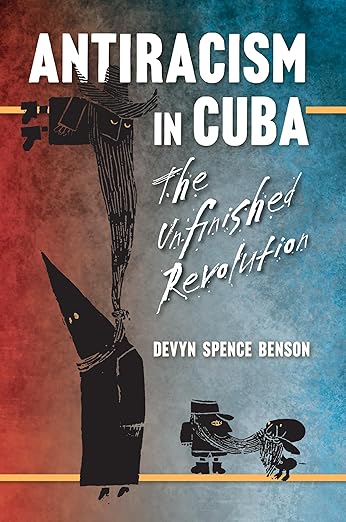
Antiracism in Cuba
The Unfinished Revolution
The University of North Carolina Press · Print & ebook · April 25, 2016
Analyzing the ideology and rhetoric around race in Cuba and south Florida during the early years of the Cuban revolution, Devyn Spence Benson argues that ideas, stereotypes, and discriminatory practices relating to racial difference persisted despite major efforts by the Cuban state to generate social equality.
We earn from qualifying purchases.
- Who it’s for
- Benson traces how antiracist campaigns could reproduce racial stereotypes in revolutionary Cuba.
- Genres
- Cuban History, Race & Discrimination, Caribbean & Latin American Studies
- Published
- The University of North Carolina Press, April 25, 2016
Nearest books
Matched by what the books are about, then ordered by what their readers also loved. Most of these share its genre: Cuban History.
 Colonial ReckoningLouis A Pérez Jr.74% match
 Revolutionary Masculinity and Racial InequalityBonnie A. Lucero73% matchAlso shares Caribbean & Latin American Studies
 Visions of Power in CubaLillian Guerra72% match
 The Origins of the Cuban Revolution ReconsideredSamuel Farber70% match
 Cuba Since the Revolution of 1959Samuel Farber67% match
 CubaAntoni Kapcia66% match
 Cuba and the U.s. EmpireJane Franklin, Noam Chomsky66% match
 Cuba's Revolutionary WorldJonathan C. Brown66% match
For younger readers: Leaving Glorytown, The Lightning Dreamer, We Are Not Yet Equal
Start with three books, and this one can be the first.
Members get a new edition every morning: a route out from their books to essays, research and talks, with the reason for each.
Start with this bookAbout this book
Analyzing the ideology and rhetoric around race in Cuba and south Florida during the early years of the Cuban revolution, Devyn Spence Benson argues that ideas, stereotypes, and discriminatory practices relating to racial difference persisted despite major efforts by the Cuban state to generate social equality.
Continue reading
Drawing on Cuban and U.S. archival materials and face-to-face interviews, Benson examines 1960s government programs and campaigns against discrimination, showing how such programs frequently negated their efforts by reproducing racist images and idioms in revolutionary propaganda, cartoons, and school materials. Building on nineteenth-century discourses that imagined Cuba as a raceless space, revolutionary leaders embraced a narrow definition of blackness, often seeming to suggest that Afro-Cubans had to discard their blackness to join the revolution. This was and remains a false dichotomy for many Cubans of color, Benson demonstrates. While some Afro-Cubans agreed with the revolution’s sentiments about racial transcendence — “not blacks, not whites, only Cubans” — others found ways to use state rhetoric to demand additional reforms. Still others, finding a revolution that disavowed blackness unsettling and paternalistic, fought to insert black history and African culture into revolutionary nationalisms. Despite such efforts by Afro-Cubans and radical government-sponsored integration programs, racism has persisted throughout the revolution in subtle but lasting ways.
Race and Revolution
Benson traces how antiracist campaigns could reproduce racial stereotypes in revolutionary Cuba.
Come here for
- 1960s government campaigns against discrimination
- Afro-Cuban efforts to press for reforms and preserve black history
Expect
- Racial rhetoric in revolutionary propaganda
- Racial imagery in school materials
Where it sits
| Race & Discrimination | 51% |
|---|---|
| Caribbean & Latin American Studies | 45% |
| Cuban History | 37% |
Percentages are BookFrontier’s reading of the book.
Publisher categories
- Cuban History
- Race & Discrimination
- Authors
- Devyn Spence Benson
- Publisher
- The University of North Carolina Press
- Published
- April 25, 2016
- Format
- Print & ebook
- Reading lane
- Cuban History