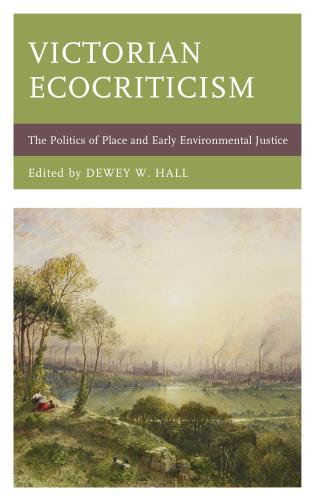
Victorian Ecocriticism
The Politics of Place and Early Environmental Justice
Bloomsbury Academic · Print & ebook · June 20, 2019
We earn from qualifying purchases.
- Who it’s for
- Essays connect Victorian literature, humanized landscapes, and early environmental justice across disciplines.
- Genres
- Nature in Literature, 19th-Century Literary Criticism, British & Irish Literary Criticism
- Published
- Bloomsbury Academic, June 20, 2019
Nearest books
Matched by what the books are about, then ordered by what their readers also loved. Most of these share its genre: Nature in Literature.
 Premodern Ecologies in the Modern Literary ImaginationVin Nardizzi, Tiffany Jo Werth68% match
 Postcolonial EcologiesElizabeth DeLoughrey, George B. Handley67% match
 EcogothicAndrew Smith, William Hughes60% match
 Writing the GoodlifePriscilla Solis Ybarra59% match
 Landscapes of Writing in Chicano LiteratureImelda Martín-Junquera57% match
 The Quest for Environmental JusticeRobert D. Bullard, Maxine Waters56% match
 The Philosophy of Social EcologyMurray Bookchin, Todd McGowan - afterword55% match
 The Ecological PlotJohn MacNeill Miller55% matchAlso shares 19th-Century Literary Criticism
For younger readers: Eyes Wide Open: Going Behind the Environmental Headlines
Start with three books, and this one can be the first.
Members get a new edition every morning: a route out from their books to essays, research and talks, with the reason for each.
Start with this bookAbout this book
Victorian Ecocriticism: The Politics of Place and Early Environmental Justice aims to take up the challenge that Lawrence Buell lays out in The Future of Environmental Criticism: Environmental Crisis and Literary Imagination (2005). Buell decries: "For in order to bring 'environmental justice into ecocriticism,' a few more articles or conference sessions won't suffice. There must be 'a fundamental rethinking and reworking of the field as a whole'" (Buell 113).
Continue reading
While discussions about nature conservation and preservation have been important within the context of ecocriticism, Buell asserts that the holy grail for the field is actually how literary critics engage in discourse about questions of place as space humanized for the purpose of tracing, disclosing, and advancing the important issue of environmental justice-as it applies to human beings, animals, and plants. The "fundamental reworking" or shift in the field of Victorian Studies really has to do with the dearth of ecocritical publishing about seminal authors and literary texts. Victorian Ecocriticism aims to participate in filling that vacuum, lack, or lacuna by featuring current research about the Victorian era from an ecocritical perspective. Victorian Ecocriticism hopes to identify, establish, and organize its content based on six themes: Ecocrisis, Ecofeminism, Ecogothicism, Ecohistoricism, Ecotheology, and Ecological Interdependence. The edited collection, thus, has two aims. First, selected places among others featured in the edition will provide environmental contexts, often with political implications: American rural landscape (e.g., Walden Pond), Australian mines, British hill-country, metropolis, mill towns, the sea, and the woods. Second, the edition includes discussions about various instances of early environmental justice evident during the mid-nineteenth century such as, but not limited to: anti-railway campaigns, biological egalitarianism, labor disputes due to adverse working conditions, patterns of displacement, reactions to Victorian scientism, resistance to enclosure, and working class education. Victorian Ecocriticism is an interdisciplinary edition. It focuses on Victorian literature as the foundational discipline linked to various disciplines such as ecology, evolutionary biology, natural history, and soil science. The topics are wide-ranging, significant, and contemporary discussing the politics of place as well as early environmental justice.
Victorian Places
Essays connect Victorian literature, humanized landscapes, and early environmental justice across disciplines.
Come here for
- Environmental contexts including Australian mines
- Discussion of anti-railway campaigns
Expect
- Six organizing themes, including ecogothicism
- Links between Victorian literature and soil science
Where it sits
| 19th-Century Literary Criticism | 77% |
|---|---|
| Nature in Literature | 72% |
| British & Irish Literary Criticism | 47% |
Percentages are BookFrontier’s reading of the book.
Publisher categories
- History
- Authors
- Dewey W. Hall, Julie M. Barst, Natalie Rose Cox
- Publisher
- Bloomsbury Academic
- Published
- June 20, 2019
- Format
- Print & ebook
- Reading lane
- History