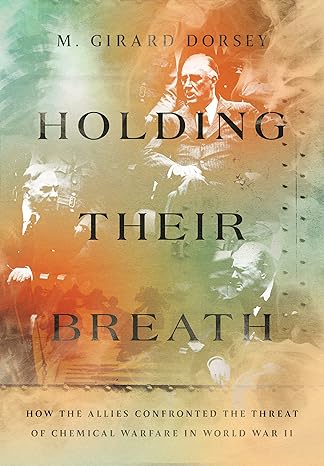
Holding Their Breath
How the Allies Confronted the Threat of Chemical Warfare in World War II
Cornell University Press · Print & ebook · March 15, 2024
We earn from qualifying purchases.
- Who it’s for
- Britain, the United States, and Canada prepared for chemical warfare rarely unleashed.
- Genres
- Chemical & Biological Warfare, World War II History, Arms Control & Security
- Published
- Cornell University Press, March 15, 2024
Nearest books
Matched by what the books are about, then ordered by what their readers also loved. Most of these share its genre: Chemical & Biological Warfare.
 Chemical WarfareFredric Brown, Frederic J. Brown71% match
 The Poisonous CloudL. F. Haber, Ludwig Fritz Haber71% match
 War of NervesJonathan Tucker71% matchAlso shares Arms Control & Security
 Chemical WarfareEdward M. Spiers, Spiers69% matchAlso shares Arms Control & Security
 Hellfire BoysTheo Emery69% match
 A History of Chemical WarfareK. Coleman, Kim Coleman67% matchAlso shares Arms Control & Security
 A Higher Form of KillingRobert Harris, Jeremy Paxman67% matchAlso shares World War II History
 Chemical WeaponryEdward M. Spiers65% matchAlso shares Arms Control & Security
For younger readers: World War Two: Under the Shadow of the Swastika, What Was World War I?, Eyewitness World War II
Start with three books, and this one can be the first.
Members get a new edition every morning: a route out from their books to essays, research and talks, with the reason for each.
Start with this bookAbout this book
Holding Their Breath uncovers just how close Britain, the United States, and Canada came to crossing the red line that restrained chemical weapon use during World War II. Unlike in World War I, belligerents did not release poison gas regularly during the Second World War.
Continue reading
Yet, the looming threat of chemical warfare significantly affected the actions and attitudes of these three nations as they prepared their populations for war, mediated their diplomatic and military alliances, and attempted to defend their national identities and sovereignty. The story of chemical weapons and World War II begins in the interwar period as politicians and citizens alike advocated to ban, to resist, and eventually to prepare for gas use in the next war. M. Girard Dorsey reveals, through extensive research in multinational archives and historical literature, that although poison gas was rarely released on the battlefield in World War II, experts as well as lay people dedicated significant time and energy to the weapon's potential use; they did not view chemical warfare as obsolete or taboo. Poison gas was an influential weapon in World War II, even if not deployed in a traditional way, and arms control, for various reasons, worked. Thus, what did not happen is just as important as what did. Holding Their Breath provides insight into these potentialities by untangling World War II diplomacy and chemical weapons use in a new way.
The Chemical Red Line
Britain, the United States, and Canada prepared for chemical warfare rarely unleashed.
Come here for
- Allied diplomacy shaped by the threat of chemical warfare
- Interwar debate over banning chemical weapons
Expect
- How arms control worked despite rare battlefield use
- Attention to poison gas’s potential use by experts and lay people
Where it sits
| Chemical & Biological Warfare | 95% |
|---|---|
| Arms Control & Security | 68% |
| World War II History | 51% |
Percentages are BookFrontier’s reading of the book.
Publisher categories
- Chemical & Biological Warfare
- World War II History
- Diplomacy
- Authors
- Marion Girard Dorsey, M. Girard Dorsey
- Publisher
- Cornell University Press
- Published
- March 15, 2024
- Format
- Print & ebook
- Reading lane
- Chemical & Biological Warfare