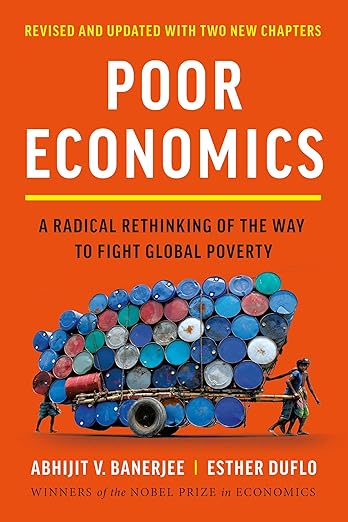
Poor Economics
A Radical Rethinking of the Way to Fight Global Poverty
PublicAffairs · Print & ebook · September 16, 2025
In this new edition of their classic work, the winners of the Nobel Prize in Economics upend the most common assumptions about how economics works, providing a “rich and humane” (Financial Times) examination of how poor people actually live Why do the poor borrow to save?
We earn from qualifying purchases.
- Who it’s for
- A careful, usefully skeptical look at how poverty policy actually works.
- Genres
- Economic Development, Poverty & Homelessness, The Developing World
- Published
- PublicAffairs, September 16, 2025
Nearest books
Matched by what the books are about, then ordered by what their readers also loved.
 Doughnut EconomicsKate Raworth63% match
 The Value of EverythingMariana Mazzucato56% match
 HumankindRutger Bregman, Erica Moore52% match
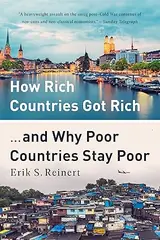 How Rich Countries Got Rich ... and Why Poor Countries Stay PoorErik S Reinert62% matchShares Economic Development
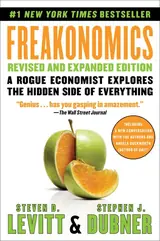 Freakonomics Revised and Expanded EditionSteven D. Levitt, Stephen J. Dubner61% match
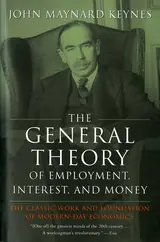 The General Theory of Employment, Interest, and MoneyJohn Maynard Keynes51% match
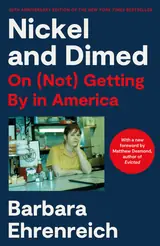 Nickel and DimedBarbara Ehrenreich, Sara Bershtel58% matchShares Poverty & Homelessness
 Rich Dad Poor DadRobert T. Kiyosaki53% match
For younger readers: Big Money, Making and Saving Money: Jobs, Taxes, Inflation... and Much More!, The Sum of US (adapted for Young Readers)
Start with three books, and this one can be the first.
Members get a new edition every morning: a route out from their books to essays, research and talks, with the reason for each.
Start with this bookAbout this book
In this new edition of their classic work, the winners of the Nobel Prize in Economics upend the most common assumptions about how economics works, providing a “rich and humane” (Financial Times) examination of how poor people actually live Why do the poor borrow to save? Why do they miss out on free lifesaving immunizations but pay for unnecessary drugs? Why do children from poor families attend school but fail to learn anything?
Continue reading
In Poor Economics, Abhijit V. Banerjee and Esther Duflo, two Nobel Prize–winning MIT professors, answer these questions based on years of field research from around the world. Together, they investigate what the lives and choices of the poor tell us about how to fight global poverty, from why microfinance is useful without being the miracle some hoped it would be to why the poor don’t want health insurance. Throughout, they reveal that even as many magic bullets of yesterday have ended up as today’s failed ideas, there is a path forward through this challenge. Updated with significant new material based on insights from the last decade of research, Poor Economics is a radical and hopeful rethinking of the economics of poverty and an intimate view of the life of the poor around the world.
Why It Clicks
A careful, usefully skeptical look at how poverty policy actually works.
Come here for
- clear-eyed development thinking
- practical, classroom-friendly framing
Expect
- layered argument
- toolkit-style takeaways
Where it sits
| Economic Development | 65% |
|---|---|
| Poverty & Homelessness | 64% |
| The Developing World | 31% |
Percentages are BookFrontier’s reading of the book.
Publisher categories
- Economic Development
- The Developing World
- Poverty & Homelessness
- Authors
- Abhijit V. Banerjee, Esther Duflo
- Publisher
- PublicAffairs
- Published
- September 16, 2025
- Format
- Print & ebook
- Reading lane
- Economic Development