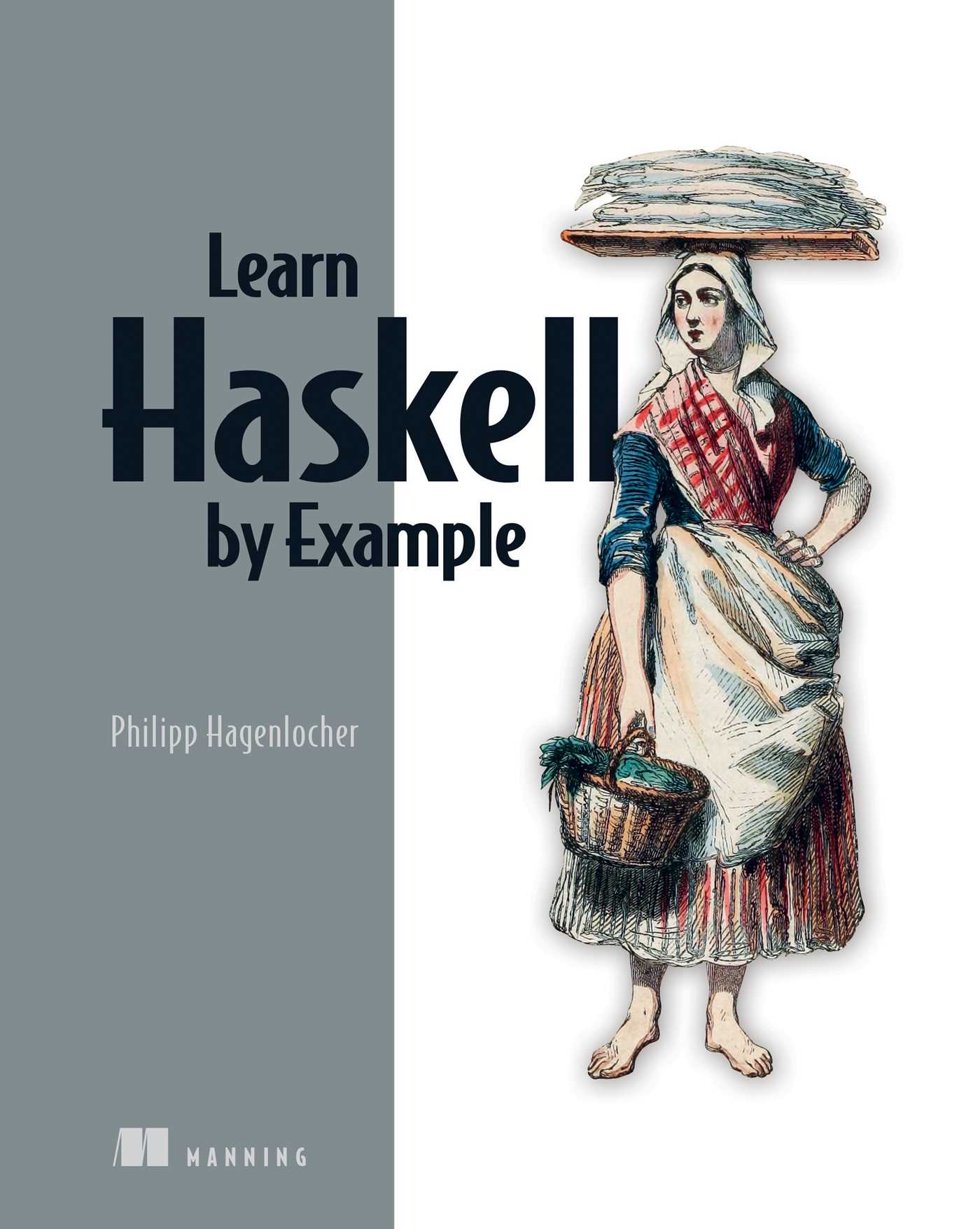
Learn Haskell by Example
Manning · Print & ebook · November 26, 2024
A discovery pick for readers interested in Learn Haskell by Example.
We earn from qualifying purchases.
- Who it’s for
- Build Haskell skills through projects that apply functional programming to practical development challenges.
- Themes
- Haskell programming, Functional programming, Debugging and performance
- Genres
- Programming Languages
Nearest books
Matched by what the books are about, then ordered by what their readers also loved. Most of these share its genre: Programming Languages.
 Haskell in DepthVitaly Bragilevsky76% match
 Learn You a Haskell for Great Good!Miran Lipovaca73% match
 Go by ExampleInanc Gumus63% match
 Learn C++ by ExampleFrances Buontempo62% match
 Clojure for the Brave and TrueDaniel Higginbotham59% match
 Tiny C ProjectsDan Gookin59% match
 Rust in ActionTim McNamara58% match
 Clojure ProgrammingChas Emerick, Christophe Grand57% match
For younger readers: Scratch 3 Programming Playground, Python for Kids, Adventures in Python
Start with three books, and this one can be the first.
Members get a new edition every morning: a route out from their books to essays, research and talks, with the reason for each.
Start with this bookAbout this book
Learn Haskell by doing Haskell projects! In this book, you’ll get practical experience writing Haskell code and applying functional programming to actual development challenges. In Learn Haskell by Example, you’ll build your Haskell skills by working through hands-on challenges and conundrums. You’ll learn to look at each project through a Haskell lens, and then solve it using features like lazy evaluation, immutable data structures, and monads.
Continue reading
In Learn Haskell by Example you will learn how to: • Use Haskell for daily programming tasks • Effectively apply functional concepts • Avoid common beginner pitfalls of Haskell • Apply abstract concepts in the Haskell language • Debug and profile Haskell applications • Improve the performance of Haskell applications Haskell is an amazing choice for applications that need an extra guarantee of safety, such as in smart contracts, data intensive applications, and large scale distributed systems. In this book, you’ll see just how practical Haskell can be for creating programs by building your own engaging projects! Learn how to structure real-world applications, how to work with the Haskell tool chain effectively, and what to look out for when writing critical sections in the program's logic. Best of all, each project in this book is fully extensible and customizable so you can keep tinkering with your favorites! Purchase of the print book includes a free eBook in PDF, Kindle, and ePub formats from Manning Publications. About the technology Programmers spend a lot of time debugging and refactoring code, reading comments and documentation, and trying to make sense out of complex designs. Haskell, a powerful, beautiful, and challenging functional programming language, promises a different path. By focusing your attention on simple functions, clearly-defined behaviors, and the right high-level abstractions, Haskell disallows the dangerous behaviors that usually lead to bugs and crashes. About the book Learn Haskell by Example teaches you to build applications in Haskell by designing and coding fun and engaging projects. In this easy-to-follow guide, you’ll create a domain specific language for music, an image processing library, and more! You’ll learn Haskell from the ground-up with a focus on important concepts like function design, composition, and data immutability. Each project gives you a new insight into how to think in Haskell and helps you understand why many Haskell developers say they will never use another language again. What's inside • Use Haskell for daily programming tasks • Purely functional programming • Avoid common Haskell pitfalls About the reader For readers who know how to program in an object-oriented language. About the author Philipp Hagenlocher is a full time Haskell developer, and the creator of the beloved Haskell for Imperative Programmers YouTube course. The technical editor on this book was Alexander Vershilov. Table of Contents 1 Introduction 2 Ancient secret keeping on modern machines 3 Every line counts 4 Line numbering tool 5 Words and graphs 6 Solving the ladder game 7 Working with CSV files 8 A tool for CSV 9 Quick checks and random tests 10 Digital music box 11 Programming musical compositions<BR&g
Haskell Through Projects
Build Haskell skills through projects that apply functional programming to practical development challenges.
Come here for
- Projects involving a music domain-specific language and an image processing library
- Practice with Haskell’s lazy evaluation and immutable data structures
Expect
- Work with debugging, profiling, and application performance
- Explore function design, composition, and data immutability
Where it sits
| Programming Languages | 82% |
|---|
Percentages are BookFrontier’s reading of the book.
Publisher categories
- Object-Oriented Programming
- Software Development
- Dev Tools & Workflow
- Authors
- Philipp Hagenlocher
- Publisher
- Manning
- Published
- November 26, 2024
- Format
- Print & ebook
- Theme
- Haskell programming · Functional programming · Debugging and performance
- Reading lane
- Object-Oriented Programming