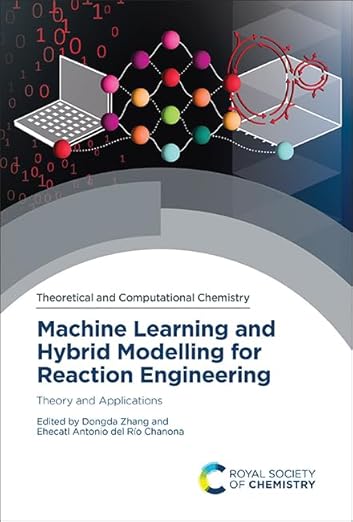
Machine Learning and Hybrid Modelling for Reaction Engineering
Theory and Applications
RSC · Print & ebook · December 20, 2023
Over the last decade, there has been a significant shift from traditional mechanistic and empirical modelling into statistical and data-driven modelling for applications in reaction engineering.
We earn from qualifying purchases.
- Who it’s for
- Theory and applications of hybrid modelling, from model construction to uncertainty analysis in reaction engineering.
- Genres
- Chemical & Biochemical Engineering, Molecular Modeling, Industrial Chemistry
- Published
- RSC, December 20, 2023
Nearest books
Matched by what the books are about, then ordered by what their readers also loved. Most of these share its genre: Molecular Modeling.
 Chemical Complexity Via Simple ModelsValeriy I. Bykov, Svetlana B. Tsybenova66% matchAlso shares Chemical & Biochemical Engineering
 Computational Chemistry and Molecular ModelingK. I. Ramachandran, Gopakumar Deepa60% match
 Computational Chemistry MethodsPonnadurai Ramasami57% match
 Understanding Molecular SimulationDaan Frenkel, Berend Smit56% match
 Chemical Kinetics, Stochastic Processes, and Irreversible ThermodynamicsMoisés Santillán, Moises Santillan56% match
 In Silico Chemistry and BiologyGirish Kumar Gupta, Mohammad Hassan Baig54% match
 Mathematical Modeling in Systems BiologyBrian P. Ingalls54% match
 Computational Chemistry for ExperimentalistsBenjamin G. Janesko53% match
Start with three books, and this one can be the first.
Members get a new edition every morning: a route out from their books to essays, research and talks, with the reason for each.
Start with this bookAbout this book
Over the last decade, there has been a significant shift from traditional mechanistic and empirical modelling into statistical and data-driven modelling for applications in reaction engineering. In particular, the integration of machine learning and first-principle models has demonstrated significant potential and success in the discovery of (bio)chemical kinetics, prediction and optimisation of complex reactions, and scale-up of industrial reactors.
Continue reading
Summarising the latest research and illustrating the current frontiers in applications of hybrid modelling for chemical and biochemical reaction engineering, Machine Learning and Hybrid Modelling for Reaction Engineering fills a gap in the methodology development of hybrid models. With a systematic explanation of the fundamental theory of hybrid model construction, time-varying parameter estimation, model structure identification and uncertainty analysis, this book is a great resource for both chemical engineers looking to use the latest computational techniques in their research and computational chemists interested in new applications for their work.
Hybrid Reaction Models
Theory and applications of hybrid modelling, from model construction to uncertainty analysis in reaction engineering.
Come here for
- Hybrid models combining machine learning with first-principles models
- Applications to kinetics, complex reactions, and reactor scale-up
Expect
- Time-varying parameter estimation and model structure identification
- Research frontiers in chemical and biochemical reaction engineering
Where it sits
| Chemical & Biochemical Engineering | 78% |
|---|---|
| Molecular Modeling | 70% |
| Industrial Chemistry | 53% |
Percentages are BookFrontier’s reading of the book.
Publisher categories
- Molecular Modeling
- Chemical & Biochemical Engineering
- Authors
- Dongda Zhang, Ehecatl Antonio del Río Chanona
- Publisher
- RSC
- Published
- December 20, 2023
- Format
- Print & ebook
- Reading lane
- Molecular Modeling