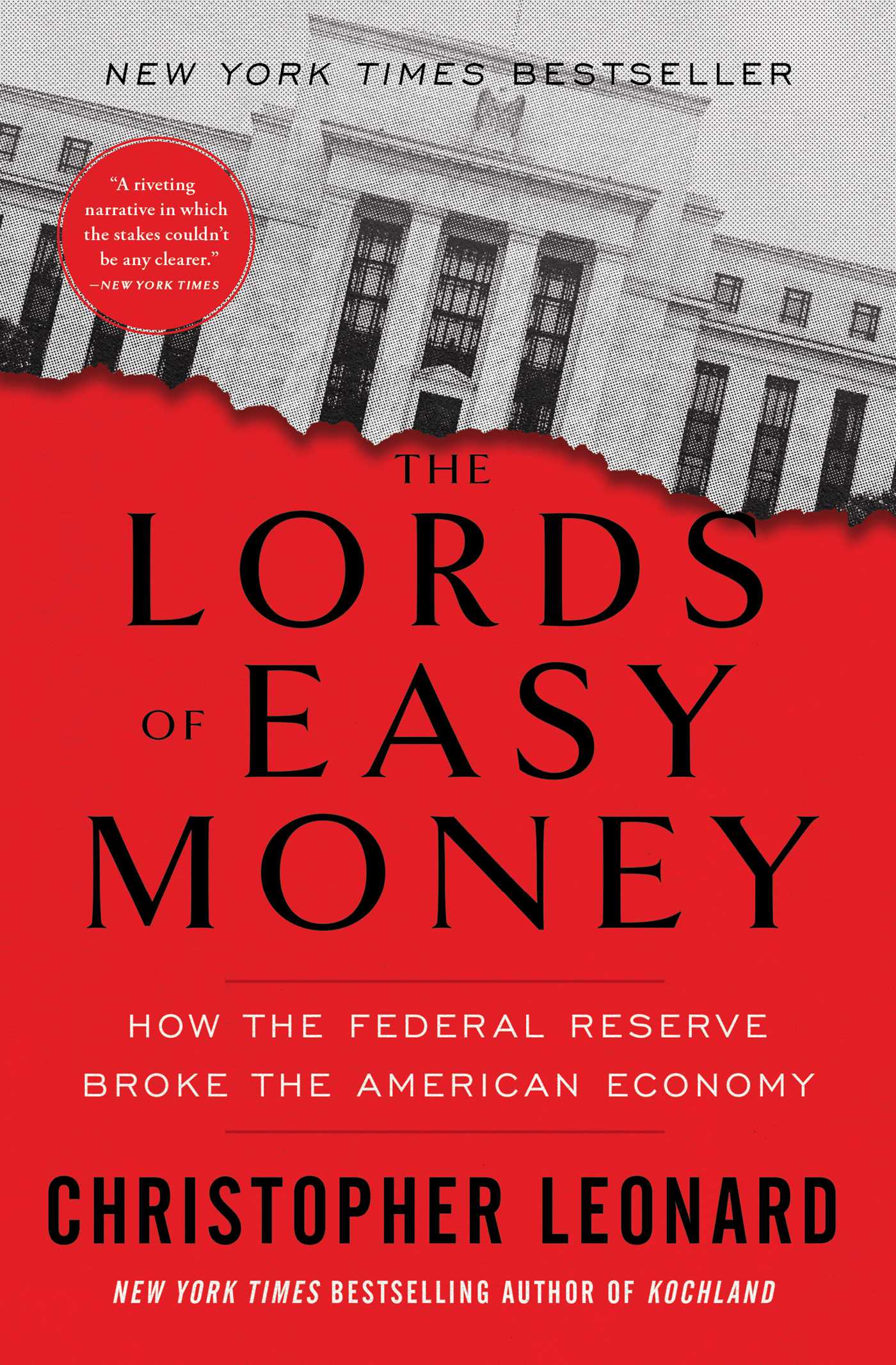
The Lords of Easy Money
How the Federal Reserve Broke the American Economy
Simon & Schuster · Print & ebook · January 10, 2023
The New York Times bestseller from business journalist Christopher Leonard infiltrates one of America’s most mysterious institutions—the Federal Reserve—to show how its policies spearheaded by Chairman Jerome Powell over the past ten years have accelerated income inequality and put our country’s economic stability at risk.
We earn from qualifying purchases.
- Who it’s for
- Christopher Leonard makes monetary policy legible through a pointed account of the Federal Reserve’s interventions.
- Genres
- Money & Monetary Policy, Macroeconomics, Economic Policy
- Published
- Simon & Schuster, January 10, 2023
Nearest books
Matched by what the books are about, then ordered by what their readers also loved. Most of these share its genre: Money & Monetary Policy.
 America's BankRoger Lowenstein74% match
 The Triumph of Economic FreedomPhil Gramm, Donald J. Boudreaux60% matchAlso shares Economic Policy
 Exorbitant PrivilegeBarry Eichengreen64% match
 Life After CapitalismGeorge Gilder57% match
 Red CapitalismCarl Walter, Fraser Howie55% match
 The Undercover Economist Strikes BackTim Harford63% matchAlso shares Macroeconomics
 Lords of FinanceLiaquat Ahamed63% match
Start with three books, and this one can be the first.
Members get a new edition every morning: a route out from their books to essays, research and talks, with the reason for each.
Start with this bookAbout this book
The New York Times bestseller from business journalist Christopher Leonard infiltrates one of America’s most mysterious institutions—the Federal Reserve—to show how its policies spearheaded by Chairman Jerome Powell over the past ten years have accelerated income inequality and put our country’s economic stability at risk. If you asked most people what forces led to today’s unprecedented income inequality and financial crashes, no one would say the Federal Reserve.
Continue reading
For most of its history, the Fed has enjoyed the fawning adoration of the press. When the economy grew, it was credited to the Fed. When the economy imploded in 2008, the Fed got credit for rescuing us. But here, for the first time, is the inside story of how the Fed has reshaped the American economy for the worse. It all started on November 3, 2010, when the Fed began a radical intervention called quantitative easing. In just a few short years, the Fed more than quadrupled the money supply with one goal: to encourage banks and other investors to extend more risky debt. Leaders at the Fed knew that they were undertaking a bold experiment that would produce few real jobs, with long-term risks that were hard to measure. But the Fed proceeded anyway…and then found itself trapped. Once it printed all that money, there was no way to withdraw it from circulation. The Fed tried several times, only to see the market start to crash, at which point the Fed turned the money spigot back on. That’s what it did when COVID hit, printing 300 years’ worth of money in a few short months. Which brings us to now: Ten years on, the gap between the rich and poor has grown dramatically, inflation is raging, and the stock market is driven by boom, busts, and bailouts. Middle-class Americans seem stuck in a stage of permanent stagnation, with wage gains wiped out by high prices even as they remain buried under credit card debt, car loan debt, and student debt. Meanwhile, the “too big to fail” banks remain bigger and more powerful than ever while the richest Americans enjoy the gains of a hyper-charged financial system. The Lords of Easy Money “skillfully” (The Wall Street Journal) tells the “fascinating” (The New York Times) tale of how quantitative easing is imperiling the American economy through the story of the one man who tried to warn us. This is the first inside story of how we really got here—and why our economy rests on such unstable ground.
Money’s Ripple Effects
Christopher Leonard makes monetary policy legible through a pointed account of the Federal Reserve’s interventions.
Come here for
- A sharp look at quantitative easing and its economic aftershocks
- The Fed’s influence on inequality, markets, and financial stability
Expect
- A critical inside account of the Fed’s choices
- Big economic consequences, told in clear, direct prose
Where it sits
| Money & Monetary Policy | 96% |
|---|---|
| Macroeconomics | 31% |
| Economic Policy | 28% |
Percentages are BookFrontier’s reading of the book.
Publisher categories
- Banks & Banking
- Economic History
- Money & Monetary Policy
- Authors
- Christopher Leonard
- Publisher
- Simon & Schuster
- Published
- January 10, 2023
- Format
- Print & ebook
- Reading lane
- Banks & Banking