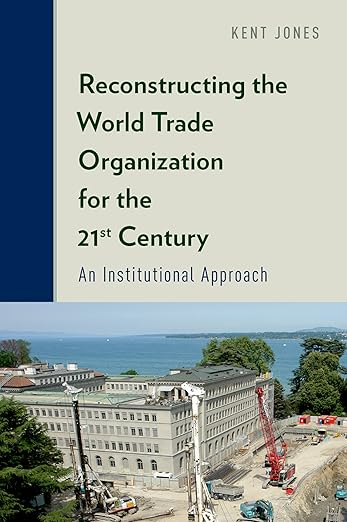
Reconstructing the World Trade Organization for the 21st Century
An Institutional Approach
Oxford University Press · Print & ebook · February 17, 2015
The institutional shortcomings of the World Trade Organization (WTO) became apparent during the Doha Round of Trade negotiations that began in 2001 and which aimed to improve the success of developing countries' trading by lowering trade barriers and adjusting other trade rules.
We earn from qualifying purchases.
- Who it’s for
- Kent Jones examines why WTO negotiations stall and considers reforms to restore their capacity for agreement.
- Genres
- Trade & Tariffs, International Economics, International Trade Law
- Published
- Oxford University Press, February 17, 2015
Nearest books
Matched by what the books are about, then ordered by what their readers also loved. Most of these share its genres: Trade & Tariffs, International Economics and International Trade Law.
 Trade Multilateralism in the Twenty-first CenturyAlexei Kireyev, Chiedu Osakwe73% match
 U.s. Trade PolicyWilliam A. Lovett, Alfred E. Eckes Jr62% match
 World Trade and Investment Law ReimaginedAlvaro Santos, Chantal Thomas61% match
 Tiger by the TailMark A. Groombridge61% match
 Breaking the WTOKristen Hopewell58% match
 GATS 2000Pierre Sauve, Pierre Sauveu56% match
 Saving Free TradeRobert Lawrence, Robert E. Litan51% match
 Trade Policy DisasterDouglas A. Irwin51% match
For younger readers: Imperialism
Start with three books, and this one can be the first.
Members get a new edition every morning: a route out from their books to essays, research and talks, with the reason for each.
Start with this bookAbout this book
The institutional shortcomings of the World Trade Organization (WTO) became apparent during the Doha Round of Trade negotiations that began in 2001 and which aimed to improve the success of developing countries' trading by lowering trade barriers and adjusting other trade rules. This "development agenda" meant different things to rich and poor countries.
Continue reading
In addition, many of the circumstances that supported success in General Agreement on Tariffs and Trade (GATT) negotiations of 1947 were no longer present after the WTO was founded in 1995. In Reconstructing the World Trade Organization for the 21st Century, Kent Jones examines the difficulties of the WTO in completing multilateral trade negotiations and possible ways to restore its ability to do so. The problem lies in the institutional structure it inherited from the GATT, which was designed for a more limited scope of trade negotiations among a relatively small number of wealthier, industrialized countries. Jones presents an institutional model of the GATT/WTO system, which describes why such an organization exists and how it is supposed to accomplish its goals. Institutional reforms will be necessary to restore the WTO's ability to complete global trade agreements, including a more flexible application of the consensus rule, a common understanding among all members about the limits of domestic policy space that is subject to negotiation, and clearer rules on reciprocity obligations. The popularity of bilateral and regional trade agreements, which have emerged as the alternative to WTO agreements, presents a threat to the WTO's relevance in trade negotiations, but also an opportunity to "multilateralize" new and deeper trade integration in future WTO agreements. Aid for trade may also play an instrumental role in bringing more developing countries into WTO disciplines. Above all, WTO members must develop new ways to find common ground in order to negotiate for mutual gains from trade.
WTO Institutional Reform
Kent Jones examines why WTO negotiations stall and considers reforms to restore their capacity for agreement.
Come here for
- An institutional model explaining how the GATT/WTO system is meant to work
- Proposals on consensus, domestic policy space, reciprocity, and aid for trade
Expect
- Discussion of the Doha Round and the WTO’s inherited institutional structure
- Analysis of bilateral and regional agreements as both a threat and an opportunity
Where it sits
| Trade & Tariffs | 49% |
|---|---|
| International Economics | 40% |
| International Trade Law | 30% |
Percentages are BookFrontier’s reading of the book.
Publisher categories
- Economics
- Authors
- Kent Jones
- Publisher
- Oxford University Press
- Published
- February 17, 2015
- Format
- Print & ebook
- Reading lane
- Economics