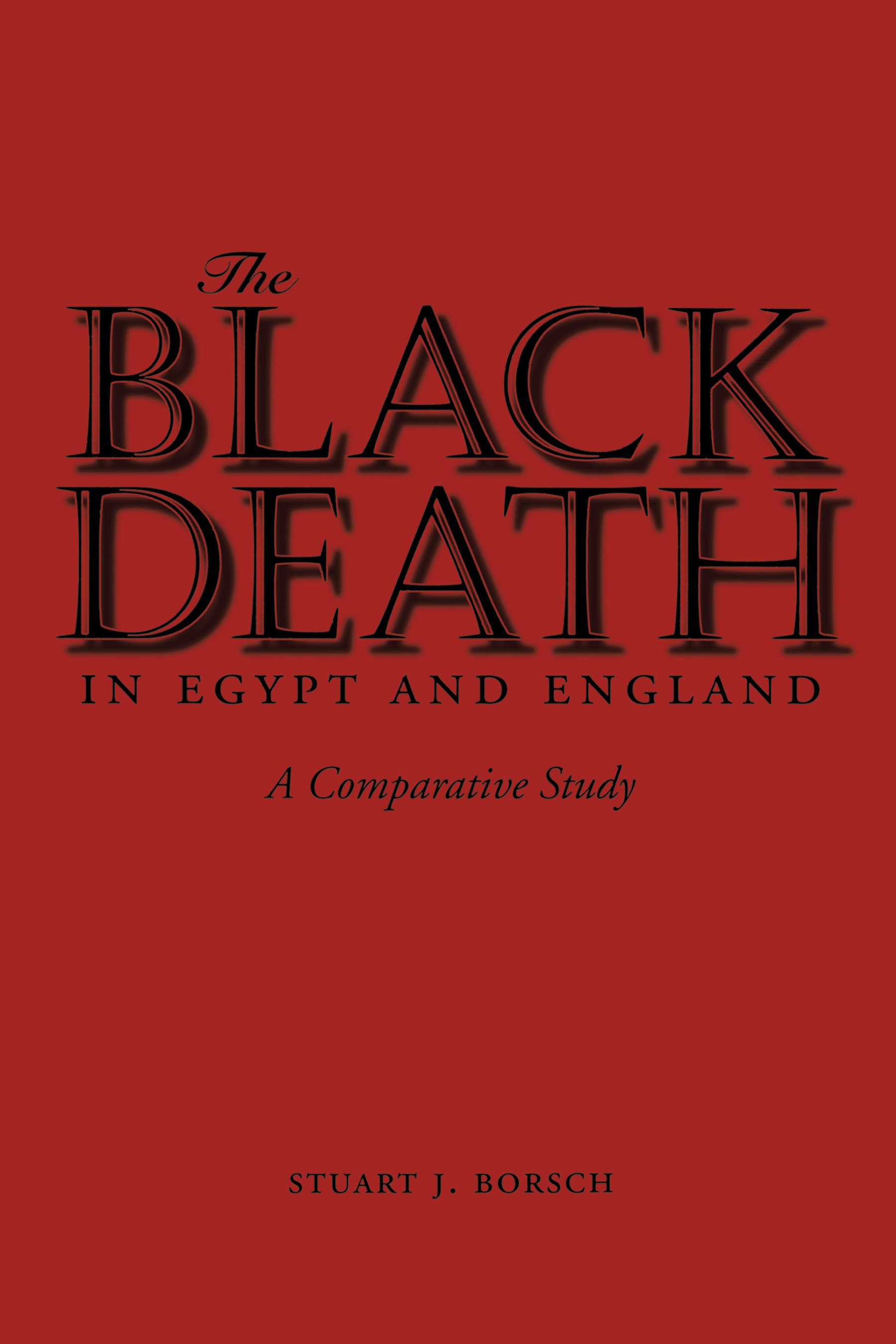
The Black Death in Egypt and England
A Comparative Study
University of Texas Press · Print & ebook · June 1, 2005
Throughout the fourteenth century AD/eighth century H, waves of plague swept out of Central Asia and decimated populations from China to Iceland.
We earn from qualifying purchases.
- Who it’s for
- Stuart Borsch compares how landholding shaped Egypt and England’s recovery from the Black Death.
- Themes
- Black Death and depopulation, Landholding systems, Economic recovery
- Genres
- Egypt & the Middle East, Medieval History, Medieval Britain (1066-1485)
Nearest books
Matched by what the books are about, then ordered by what their readers also loved.
 The Black DeathPhilip Ziegler66% matchShares Medieval History
 The Great MortalityJohn Kelly65% matchShares Medieval History
 The Black DeathJohn Hatcher61% matchShares Medieval Britain (1066-1485)
 PathogenesisJonathan Kennedy55% match
 CivilizationNiall Ferguson52% match
 Cathedral, Forge and WaterwheelJoseph Gies51% matchShares Medieval History
 Outbreak!Beth Skwarecki50% match
For younger readers: What Was the Plague?, When Plague Strikes, I Survived the Black Death, 1348 (i Survived #24)
Start with three books, and this one can be the first.
Members get a new edition every morning: a route out from their books to essays, research and talks, with the reason for each.
Start with this bookAbout this book
Throughout the fourteenth century AD/eighth century H, waves of plague swept out of Central Asia and decimated populations from China to Iceland. So devastating was the Black Death across the Old World that some historians have compared its effects to those of a nuclear holocaust.
Continue reading
As countries began to recover from the plague during the following century, sharp contrasts arose between the East, where societies slumped into long-term economic and social decline, and the West, where technological and social innovation set the stage for Europe's dominance into the twentieth century. Why were there such opposite outcomes from the same catastrophic event? In contrast to previous studies that have looked to differences between Islam and Christianity for the solution to the puzzle, this pioneering work proposes that a country's system of landholding primarily determined how successfully it recovered from the calamity of the Black Death. Stuart Borsch compares the specific cases of Egypt and England, countries whose economies were based in agriculture and whose pre-plague levels of total and agrarian gross domestic product were roughly equivalent. Undertaking a thorough analysis of medieval economic data, he cogently explains why Egypt's centralized and urban landholding system was unable to adapt to massive depopulation, while England's localized and rural landholding system had fully recovered by the year 1500.
Landholding After Plague
Stuart Borsch compares how landholding shaped Egypt and England’s recovery from the Black Death.
Come here for
- A comparison of Egypt and England’s landholding systems
- An account of economic recovery after the Black Death
Expect
- Centralized, urban landholding in Egypt
- Localized, rural landholding in England
Where it sits
| Medieval Britain (1066-1485) | 46% |
|---|---|
| Egypt & the Middle East | 43% |
| Medieval History | 34% |
Percentages are BookFrontier’s reading of the book.
Publisher categories
- Economic History
- Medieval History
- Medical History
- Authors
- Stuart J. Borsch
- Publisher
- University of Texas Press
- Published
- June 1, 2005
- Format
- Print & ebook
- Theme
- Black Death and depopulation · Landholding systems · Economic recovery
- Reading lane
- Economic History