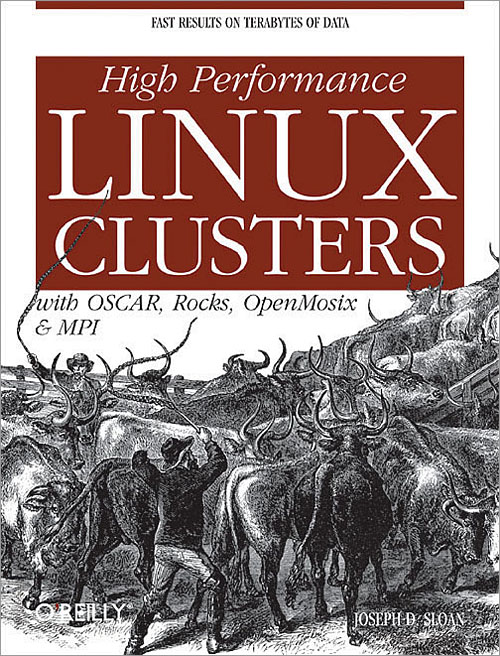
High Performance Linux Clusters With OSCAR, Rocks, Openmosix, and MPI
A Comprehensive Getting-started Guide
O'Reilly Media · Print & ebook · December 21, 2004
To the outside world, a "supercomputer" appears to be a single system.
We earn from qualifying purchases.
- Who it’s for
- Plan and deploy a Linux cluster, from hardware choices and installation to software and performance tuning.
- Themes
- High-performance computing, Linux cluster deployment, Clustering software
- Genres
- Linux & UNIX Admin, Parallel Programming, Client-Server Computing
Nearest books
Matched by what the books are about, then ordered by what their readers also loved. Most of these share its genre: Linux & UNIX Admin.
 Linux System AdministrationTom Adelstein, Bill Lubanovic65% match
 How Linux Works, 3rd EditionBrian Ward61% match
 Learning Modern LinuxMichael Hausenblas59% match
 Understanding the Linux KernelDaniel Bovet, Marco Cesati58% match
 Systems PerformanceBrendan Gregg58% match
 Linux in ActionDavid Clinton58% match
 Practical Guide to Fedora and Red Hat Enterprise Linux, aMark G. Sobell58% match
 The Linux Command Line, 3rd EditionWilliam Shotts57% match
Start with three books, and this one can be the first.
Members get a new edition every morning: a route out from their books to essays, research and talks, with the reason for each.
Start with this bookAbout this book
To the outside world, a "supercomputer" appears to be a single system. In fact, it's a cluster of computers that share a local area network and have the ability to work together on a single problem as a team. Many businesses used to consider supercomputing beyond the reach of their budgets, but new Linux applications have made high-performance clusters more affordable than ever.
Continue reading
These days, the promise of low-cost supercomputing is one of the main reasons many businesses choose Linux over other operating systems. This new guide covers everything a newcomer to clustering will need to plan, build, and deploy a high-performance Linux cluster. The book focuses on clustering for high-performance computation, although much of its information also applies to clustering for high-availability (failover and disaster recovery). The book discusses the key tools you'll need to get started, including good practices to use while exploring the tools and growing a system. You'll learn about planning, hardware choices, bulk installation of Linux on multiple systems, and other basic considerations. Then, you'll learn about software options that can save you hours--or even weeks--of deployment time. Since a wide variety of options exist in each area of clustering software, the author discusses the pros and cons of the major free software projects and chooses those that are most likely to be helpful to new cluster administrators and programmers. A few of the projects introduced in the book include: - MPI, the most popular programming library for clusters. This book offers simple but realistic introductory examples along with some pointers for advanced use. - OSCAR and Rocks, two comprehensive installation and administrative systems - openMosix (a convenient tool for distributing jobs), Linux kernel extensions that migrate processes transparently for load balancing - PVFS, one of the parallel filesystems that make clustering I/O easier - C3, a set of commands for administering multiple systems Ganglia, OpenPBS, and cloning tools (Kickstart, SIS and G4U) are also covered. The book looks at cluster installation packages (OSCAR & Rocks) and then considers the core packages individually for greater depth or for folks wishing to do a custom installation. Guidelines for debugging, profiling, performance tuning, and managing jobs from multiple users round out this immensely useful book.
Linux Cluster Building
Plan and deploy a Linux cluster, from hardware choices and installation to software and performance tuning.
Come here for
- Planning, hardware choices, and bulk Linux installation across multiple systems
- Comparisons of cluster software, including MPI, OSCAR, Rocks, and PVFS
Expect
- Introductory MPI examples, with pointers toward advanced use
- Guidance on debugging, profiling, job management, and performance tuning
Where it sits
| Parallel Programming | 56% |
|---|---|
| Linux & UNIX Admin | 43% |
| Client-Server Computing | 37% |
Percentages are BookFrontier’s reading of the book.
Publisher categories
- Computers
- Computer Graphics
- Information Technology
- UNIX Systems
Show all 6 publisher categories
- Linux Systems
- Programming Basics
- Authors
- Joseph Sloan
- Publisher
- O'Reilly Media
- Published
- December 21, 2004
- Format
- Print & ebook
- Theme
- High-performance computing · Linux cluster deployment · Clustering software
- Reading lane
- Computers